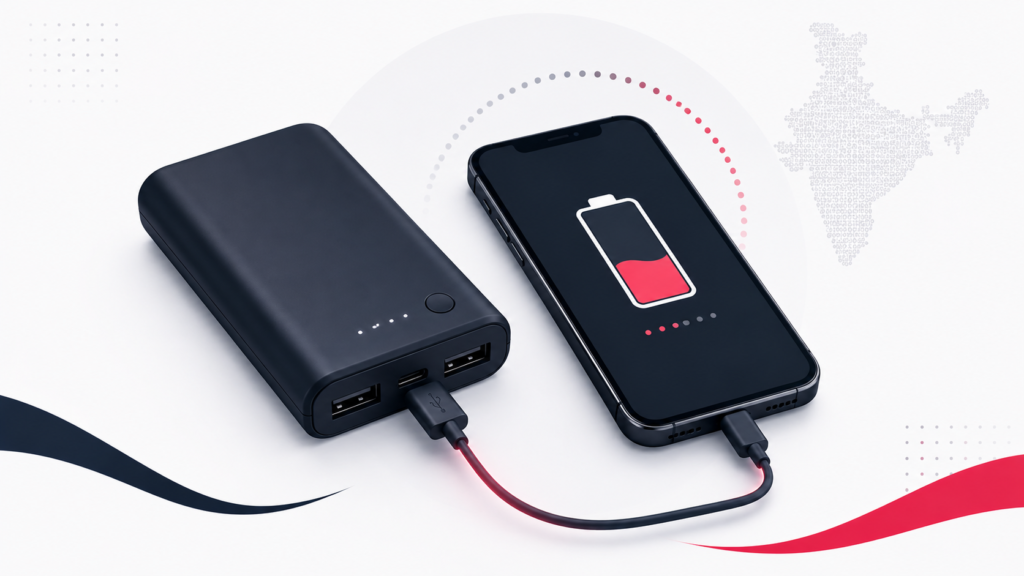
You buy a 10,000mAh power bank. Your phone has a 5,000mAh battery. Naturally you expect two full charges. Then in real life you get one and a bit, and you wonder if you have been cheated. You have not — but the number on the box is genuinely misleading, and once you understand why, you will buy power banks more wisely.
What mAh actually measures
mAh stands for milliamp-hour. It is a measure of electrical charge — roughly, how much current a battery can supply over time. A higher mAh means more stored charge. So far so good.
The catch is hidden in the small print: that mAh number is measured at the battery’s internal voltage, not the voltage your phone receives. The lithium cells inside a power bank run at about 3.7 volts. But the USB port that charges your phone outputs 5 volts (or more, with fast charging). Energy has to be “stepped up” from 3.7V to 5V — and when voltage goes up, the deliverable mAh goes down, because the total energy stays the same.
The rough rule of thumb
Between voltage conversion and other losses, a power bank delivers only about 60-70% of its labelled mAh to your devices. So:
- A “10,000mAh” power bank realistically delivers roughly 6,000-6,800mAh.
- A “20,000mAh” power bank realistically delivers roughly 12,000-13,500mAh.
That is not a defect or a scam — it is physics, and it applies to every brand. A good way to estimate real-world charges: take the labelled capacity, multiply by about 0.65, then divide by your phone’s battery size. A 10,000mAh bank (~6,500mAh real) charging a 5,000mAh phone gives you roughly one full charge plus a useful top-up — not two.
Where the missing energy goes
Three things eat into the rated number:
- Voltage conversion loss. Stepping 3.7V up to 5V is the biggest single factor. This alone accounts for most of the gap.
- Circuit inefficiency. The regulation circuitry gives off heat. That heat is energy that did not reach your phone. Better-quality power banks waste less here; cheap ones waste more.
- Cutoff thresholds. To protect the cells, a power bank stops discharging before the battery is bone-dry. That leaves a small slice of capacity permanently unused.
Battery age matters too — a power bank a few years old delivers less than when it was new.
Why a bigger number is not always the better buy
It is tempting to just buy the highest mAh you can afford. Resist that. Two things matter at least as much as raw capacity:
- Charging speed and protocol. A 10,000mAh power bank that supports modern fast charging (USB Power Delivery, or PPS) is far more useful day-to-day than a 20,000mAh one stuck at slow 5W output. Speed is often the feature you actually feel.
- Size and weight. Capacity has a physical cost. A 20,000mAh bank is heavy and bulky. If you are topping up a phone during a workday, a 10,000mAh model you will actually carry beats a 20,000mAh brick that stays at home.
How to read a power bank listing sensibly
When you are comparing power banks, look past the big front-of-box number and check:
- Rated / output capacity, if listed — some honest brands print the real deliverable figure (e.g. “rated 6,000mAh”) alongside the cell capacity. That smaller number is the truthful one.
- Output wattage and fast-charging support — look for USB-C Power Delivery and a wattage that matches your phone’s fast-charging speed.
- Number and type of ports — USB-C in/out is now the sensible default.
- Weight — be honest about what you will carry.
The bottom line
The mAh on the box is the capacity of the cells inside, not what reaches your phone. Expect about two-thirds of it in real use, and judge a power bank on charging speed and portability as much as raw capacity. A 10,000mAh fast-charging power bank is the right answer for most people far more often than a giant slow one.